

Leadership is a system, not a trait
Every organisation has a leadership system. Whether it has been designed or not.
In poorly designed systems, pressure concentrates. It gets absorbed by individuals through overload, silence, workarounds, and quiet ethical compromise.
In well-designed systems, pressure is distributed. Clarity, connection, and decision-making are carried collectively, by consistent leadership behaviour, not by the personal style of whoever happens to be in the room.
The Well-Led System makes this distinction operational. Leadership becomes infrastructure rather than personality. Behaviour becomes the control mechanism. Outcomes become repeatable instead of accidental.
The Well-Led System makes leadership behaviours operational. Leadership becomes infrastructure rather than personality. Behaviour becomes the control mechanism.
Outcomes become repeatable instead of accidental.
Three behaviours, held together
The system is built on three leadership behaviours. Each one creates a specific operating condition. When all three hold, the system holds.
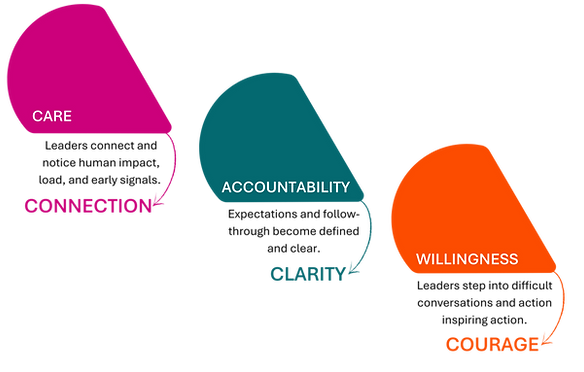
The Well-Led Leadership Behaviour System
The behaviours that hold the system. Together, they prevent ethical fade and moral injury.
These are not values. They are observable behaviours, felt under pressure. Because they are observable, they are teachable, coachable, measurable, and governable

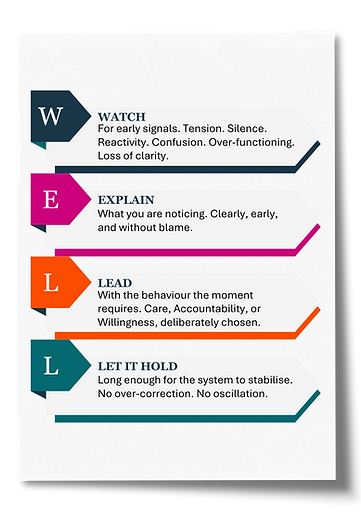
The mechanism leaders use under pressure
Under pressure, leadership behaviour narrows. Attention shortens. Decisions speed up. Familiar habits take over.
WELL is the simple, repeatable mechanism that helps leaders notice early, respond deliberately, and restore balance before harm occurs.

Download the
Well-Led System Overview
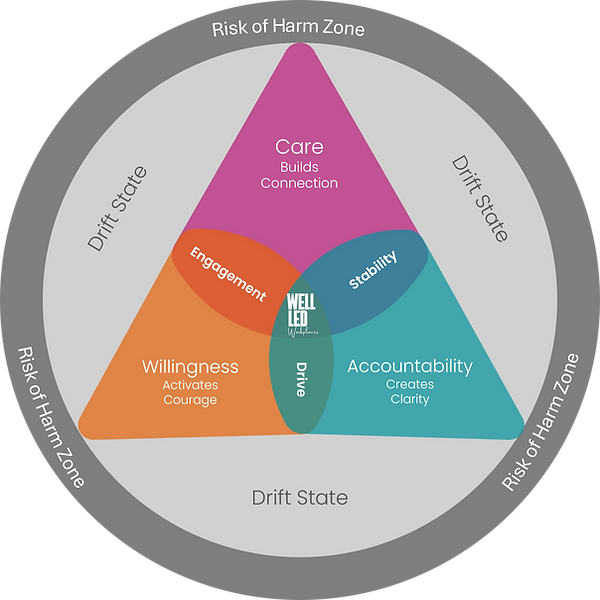
Drift, the predictable imbalance
Under pressure, leadership behaviour narrows. Drift is normal, predictable, and reversible when noticed early.
-
Drive Drift Accountability and Willingness without Care. Output continues. Connection thins. People hide mistakes and absorb load in silence.
-
Stability Drift Care and Accountability without Willingness. The system feels safe. Difficult truths get softened or delayed. Adaptation slows.
-
Engagement Drift Care and Willingness without Accountability. Energy is present. Voice is present. Clarity erodes and effort scatters.

Drift is not failure. It is a signal that the system requires recalibration.

The Risk of Harm Zone
When drift is left unaddressed, pressure stops being carried by the system. It is absorbed directly by people.
By the time the obvious signs appear, sustained overload, persistent silence, ethical shortcuts, visible fatigue, harm has already occurred.
Burnout, psychological injury, and moral injury are lag indicators. They tell you what the system has been doing, not what it is doing now.
This is why the work is upstream. Leadership behaviour is the control mechanism. When behaviour is consistent, deliberate, and held under pressure, harm is prevented at its source.
READY FOR ANYTHING
A Well-Led Workplace is not protected from pressure. It is positioned to meet it.
Ready for Anything is the position of the Well-Led System.
It does not mean preparing for every possible scenario. It means leadership behaviour that holds steady when conditions do not. Performance that is repeatable rather than accidental. People who remain capable of doing the work, again, under pressure, without harm.

Upstream of the work you are already doing
Leadership behaviour is upstream of every standard, framework, and program your organisation already runs. When behaviour holds, the rest holds with it. When it drifts, none of it does what it was designed to do.
Most organisations are already investing in the right things. ISO certifications. Psychosocial risk frameworks. ESG reporting. Mental health programs. Leadership training. Each one is built to protect or strengthen something that matters.
But every one of these depends on leadership behaviour to hold under pressure. ISO 9001 quality systems fail when leaders carry ambiguity or avoid hard conversations. ISO 45003 psychosocial controls fail when leaders cannot notice human load early. ESG social claims become indefensible when behaviour does not match stated values. Mental health programs become reactive when prevention is left to individuals.
The Well-Led System is the leadership capability layer these frameworks depend on but do not teach or verify. It does not replace any of them. It makes them work.
ISO 9001 -
Quality Management
Leadership behaviour stabilises process under pressure, so quality holds when conditions do not.
ISO 45003 - Psychological Health & Safety
Leaders are equipped to notice human load and act before psychosocial injury occurs.
ESG -
Social Sustainability
Leadership behaviour becomes the auditable control mechanism, not a stated intent.
Mental Health & Psychological Safety
Prevention through leadership behaviour reduces the escalation that response programs are built to absorb.
Download the
Well-Led System Overview
We want to hear from you
Level 7, 154 Melbourne Street
South Brisbane, Queensland 4101
