

You have the structures, the policies, and the frameworks. The question this work answers is whether your board's behaviour holds when the structures are tested.
Where boards are now
Boards today are carrying more than they were five years ago. Expectations have shifted. Obligations have expanded. Scrutiny has sharpened. The questions that used to sit downstream now arrive at the boardroom table.
Psychosocial safety. Cultural integrity. ESG accountability. Workforce wellbeing. The accountability that boards now carry for what happens across an organisation - not just for the strategic and financial decisions, but for the behavioural conditions those decisions create - has changed the work of governance itself.
Most boards have governance covered on paper. Policies. Charters. Frameworks. Compliance regimes. Risk registers. The structural architecture is in place.
What is rarely codified is the behavioural architecture. How the board challenges. How dissent is welcomed or absorbed. How dominant voices are balanced. How the board notices when its own decisions are creating downstream pressure. How it recalibrates when reality shifts.
When pressure rises in the boardroom, behaviour is what holds or fails. Polite silence replaces constructive challenge. Decisions are settled before they are interrogated. Difficult signals do not reach the table. The structures stay intact and the governance still drifts.
Governance structures set the rules. Leadership behaviour determines whether those rules hold under pressure.
Built on the Well-Led System
This work is grounded in the Well-Led System, our leadership behaviour framework built on three behaviours that hold under pressure:
Care, Accountability, and Willingness.
The Well-Led System makes leadership behaviour explicit, repeatable, and observable. In the boardroom, that means three behaviours that determine whether governance holds when it matters. Each one shows up in specific, observable directorial action.
Three behaviours, held together that hold governance under pressure
The Well-Led System defines the three behaviours that determine whether a board governs well when it matters.
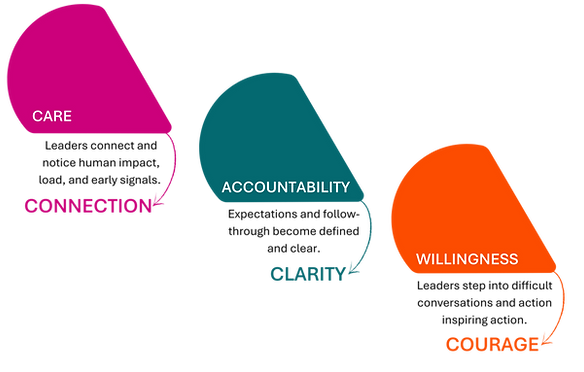
The Well-Led Leadership Behaviour System
The behaviours that hold the system. Together, they prevent ethical fade and moral injury.
These are not values statements. They are observable behaviours. You can see them in a board meeting. You can measure whether they are present.
What the Program Addresses
Leading Board Behaviour is a governance advisory engagement, not a leadership workshop. The work is targeted, diagnostic-led, and built around the behaviour patterns operating in your boardroom specifically.
The behaviour gap
The distance between what your board knows and what your board does under pressure. Named directly, addressed directly.
The downstream cost
Board decisions create the conditions executives and team leaders work inside. Drift at board level is absorbed by the system below. The program builds signal-receptive governance: the mechanism for reality to reach the table.
The Charter that holds
A Charter of Leading Board Behaviour, built in the room, owned by directors, designed to hold under pressure. Not a values statement. A working agreement on how this board behaves when it matters most.
Built on diagnostic, not assumption
Every Leading Board Behaviour engagement is customised to your board's actual composition, using validated profiling data from the Team Management Profile suite.


What the TMP Suite brings to the boardroom
Governance intelligence, not personality testing. The data shows how this board naturally processes information, makes decisions, and organises its work. It surfaces the patterns directors are already operating inside but rarely see. Used in the room, it transforms the conversation from theoretical to specific.
How The Engagement Runs
The engagement runs across three stages over approximately three months. The work is sequential. Each stage builds the conditions for the next.
01. Diagnostic
Each director completes the Team Management Profile. Julie analyses the board's collective composition and pre-session reflections. The output is a tailored facilitation plan built around your board's actual patterns.
02. Session
A four-hour facilitated session with the full board. Profile data is used directly in the room. Directors examine their behavioural patterns, practise constructive challenge through a real-time scenario, and build the Charter of Leading Board Behaviour together.
03. Charter & embedding
The Charter is finalised within 48 hours of the session and signed off by the board. A 90-Day Behaviour Integration Guide supports each director through the embedding period. At three months, a review session tests what has held, what has drifted, and what the board needs next.

Your Facilitator
The work in your boardroom is led personally by Julie Gillespie, founder of Well-Led Workplaces and architect of the Well-Led System.
Julie brings three decades of leadership experience across complex, high-pressure environments, and a deep research foundation in how leadership systems hold or fail. She is an Executive MBA, a Mental Health First Aid Master Instructor, and an accredited practitioner across the Team Management Profile suite.
She designed the Leading Board Behaviour program from the ground up, drawing on the Well-Led System doctrine, the TMP evidence base, and direct work with executive teams and boards across hospitality, ports, technical environments, and complex multi-disciplinary organisations.
For boards engaging this work now, Julie is in the room from first conversation through to three-month review. The program is delivered by its designer, with the methodology at its sharpest.
"Boards today are carrying obligations and expectations that have shifted significantly, and many are still working out what that means for how they show up. I work alongside boards to find their footing in that territory — to establish, deliberately, how they will represent the organisation and what good looks like in their boardroom." Julie Gillespie


